Episode 1

What is Novelia?

Novelia is an AI-powered platform to read original light novels and fan fiction, create your own in just a few taps, and chat with the characters. New, illustrated episodes arrive daily — free to start.

Learn more about Novelia →New sign-ups get 5,000pt
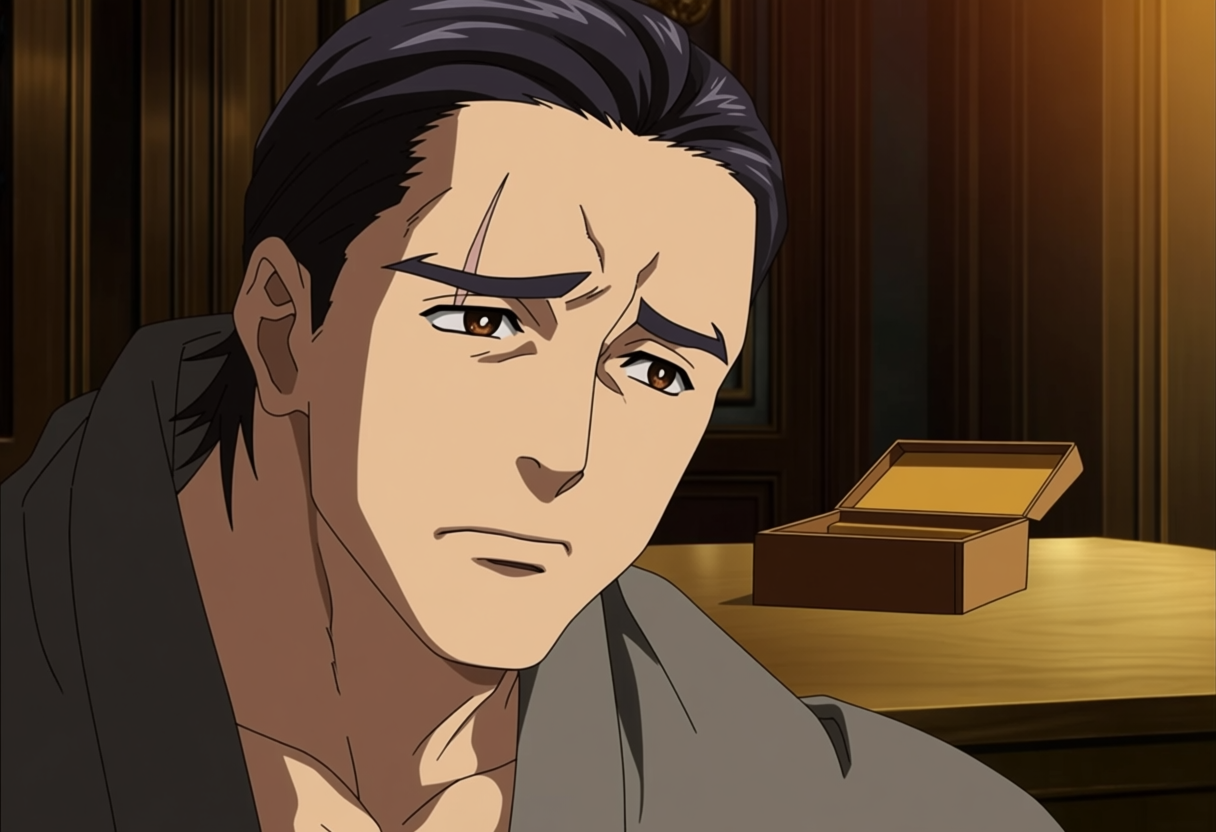
Yamato Afterglow: Beyond Loss, With You Episode 1: Ash and Notebook

Misumi Aoteru (NIPPON SANGOKU: The Three Nations of the Crimson Sun) — illustration from the fan fiction "Yamato Afterglow: Beyond Loss, With You" Episode 1 "Ash and Notebook"
The tobacco smoke drifted slowly into the dusk-lit room, dissolving in the still air. Misumi Aoteru remained seated at the desk where he'd just finished writing his resignation, pressing the cigarette between his fingers into the ashtray. The small sound of the ember being crushed seemed unnaturally loud. Five days ago, his wife Koki had been executed. Aoteru let his gaze fall on the gray hitatare folded beside the desk. The official robes of a shunoukan—an agricultural administrator. He would never wear them again. The black hakama that wrapped his slender frame felt looser than it had five days ago. His deep brown eyes reflected the resignation letter on the desk. *Ehime County Agricultural Administrator, Misumi Aoteru — resigning for personal reasons.* That was what he'd written. He couldn't bring himself to write the real reason. "Personal reasons" could never be enough. From outside the window came the faint sounds of the neighboring house preparing the evening meal. Aoteru smoothed his black hair—parted seven-to-three—and touched the small old scar at the tail of his left eyebrow. A wound from a fall in childhood. Every time Koki saw it, she'd laugh. *You've been falling down since you were a little one, haven't you?* That voice was gone now. Aoteru stood and reached for the small wooden box hanging on the wall. It held Koki's belongings. His wife had been reduced to ash in the incinerator—no bones, no grave. He'd meant to sort through her things, at least, but hadn't been able to bring himself to touch the box until today. When he lifted the lid, the faint scent of cheap perfume drifted out. Koki's scent. Aoteru couldn't move for a while, the lid still open in his hands. Inside the box were the wooden comb Koki had used, an indigo hand towel, a notebook she'd been reading, and a red braided cord from their wedding ceremony. The wedding had been just three months ago. Her father, Higashimachi Nobuto, had fallen ill and died only days later. "Nobuto-san..." Aoteru mouthed his father-in-law's name without sound. Nobuto, who had been the director of the Ehime County Library, had taken in Aoteru after he lost his parents and raised him as his own. It was Nobuto who had given Koki to him in marriage. Koki was Nobuto's only daughter. Nobuto used to say that Aoteru's head was stubborn, but that was precisely why he was so upright. And Koki had been trying to make that Aoteru laugh since they were children. Aoteru reached into the bottom of the box. His fingertips brushed something hard. He pulled it out—a notebook wrapped in indigo cloth. On the cover, in Koki's handwriting, were the words "Memoranda." Aoteru held the notebook in both hands and sat back down at the desk. Ink stains from paper darkened his fingertips, visible in the dim room. The fingers of a shunoukan who had written ledgers all his life. He lit a cigarette. Feeling the smoke spread through his lungs, Aoteru opened the notebook. The first few pages were records of everyday purchases. The price of rice, the price of salt, the day she bought dried fish. Koki's round handwriting lined up leisurely across the page. Aoteru turned the pages, reading as though tracing the time she had been alive. Then the tone of the entries changed. "Matoba, third round of green-field taxation. The village headman of Tamura wept, saying he had no seed rice left this year." Aoteru's fingers stopped. Matoba Shigeyuki—a tax collector dispatched to Ehime County. Under Yamato's tax system, the annual tribute was fixed at forty percent of the harvest. But Matoba levied taxes while the rice was still green, then levied the main tax again after harvest, and then made a third collection under the pretext of "shortfall." Triple exploitation. Aoteru knew. As a shunoukan, he had witnessed the farmers' plight countless times. But Matoba was a tax official dispatched by the Ministry of Internal Affairs, and a county agricultural administrator had no standing to interfere. The notebook documented Matoba's methods of extortion in meticulous detail. From which village, when, and how much rice was taken. Even the farmers' names were written down. Koki's handwriting grew more disordered as the pages progressed. Anger bled into the strokes. And then, on one page, Aoteru caught his breath. "To Ugaki Masatomi—ten ryo. Third-month remittance." Ugaki Masatomi—an official under the direct authority of Taira Tonoki. Internal Affairs Minister Taira Tonoki was the man who held real power in Yamato. The most fearsome figure in the nation, who controlled the government while relegating the Emperor to a figurehead. Matoba was remitting bribes in units of ten ryo to this man's direct subordinate. Ten ryo was ten thousand mon—equivalent to a farmer's annual income. Aoteru drew deeply on his cigarette. The smoke burned his throat. The trembling in his fingers as he turned the pages was not solely from the tobacco. Further on, he found a draft titled "Petition to the Internal Affairs Minister." In Koki's hand, the reality of Matoba's extortion, the remittances to Ugaki, and the farmers' suffering were all laid out in the form of a formal appeal. Aoteru closed his eyes. The scene from five days ago rose behind his eyelids. On the day Taira Tonoki's inspection tour entered Ehime County, Koki—unable to bear Matoba's tyranny any longer—had struck back in front of the tax collector. A woman who despised injustice above all else, she had cursed Matoba to his face for seizing rice from the farmers. That night, Matoba denounced her for "assaulting a tax official." Under the collective responsibility system—Yamato's penal code that punished the families of serious criminals—Koki was beheaded the following morning. She was sixteen. Aoteru had tried to protest. But Matoba had said: "This is the Internal Affairs Minister's judgment. If you have a complaint, go to Osaka." Koki had not died because of an emotional outburst. The notebook made that clear. She had grasped evidence of systematic embezzlement. That was why she was killed. Aoteru gripped the notebook. His fingertips dug into the paper. "I will..." His voice came out hoarse. Aoteru set the notebook on the desk and stubbed out his cigarette. Then he reached for the last section of the notebook. The final pages had been torn out violently. Aoteru frowned. He traced the torn edges with his finger. The paper fibers were jagged and uneven. If Koki had torn them herself, she would have cut them more carefully. Someone had ripped them out in haste—that was the kind of tear it was. Aoteru brought his face close to the torn edges, checking the quality of the paper and the state of the ink. Compared to the other pages, the yellowing around the tear was fainter. The ink bleed was fresher too. These pages had been removed just before Koki died. Who? Aoteru thought. One of Matoba's men. Or someone in Ugaki's employ. On the morning Koki was killed, someone had examined this notebook and torn out only the inconvenient pages. That was the natural conclusion. But why hadn't they taken the whole notebook? Aoteru opened the last intact page. There, Koki's hurried scrawl remained. "I wanted to see your map make the three kingdoms one." Aoteru read that single line over and over. Three kingdoms—Yamato, Buko, and Seii. An age of war in which three nations fought. This continent had once been a unified dynasty called the Kōrin Dynasty, but three hundred years ago civil strife had split it into three. Since then, the fighting had never ceased. Koki had said to Aoteru while she was alive: *Your strategic mind could help reunify the three kingdoms of Japan.* Aoteru had taken her words as a wife's idle fancy. He was just a shunoukan whose hobby was drawing maps. Ending a war—such a dream was far beyond his station. But Koki had been serious. Aoteru lit a cigarette. Exhaling smoke, he looked at Koki's scrawl once more. She had believed that the maps Aoteru drew would make the three kingdoms one. And to that end, she had been trying to expose Tonoki's embezzlement. Aoteru held the notebook to his chest. "I'll show you." He said it aloud. Not for anyone to hear. "Koki. With my map, I'll make the three kingdoms one." Aoteru stood. He knew what he had to do. First, trace where the missing pages had gone. Then, carrying on Koki's dying wish, go to Osaka—to the capital where Internal Affairs Minister Taira Tonoki resided. But before that, there was something he needed to confirm. Aoteru headed for the remains of the furnace where Koki's body had been cremated. The county's communal incinerator, about half an hour's walk from his home. He walked quickly through the deepening dusk. No one was at the incinerator. The stone furnace was cold, and a thin layer of ash had settled around it. Aoteru stood before the furnace and couldn't move for a moment. Here Koki had become ash. Not even permitted to have her bones collected—just reduced to ash. Aoteru crouched and began searching through the ash. Were there any bone fragments left unburned—no, there weren't. Koki's body had been completely incinerated. But his fingertips touched paper. Aoteru carefully brushed away the ash and picked up the scrap. It was a charred fragment of the notebook. The edges had curled from the heat, and some of the characters were gone. But there was a readable portion. "...Village, forty-two bales. Nakamura, thirty-eight bales..." Numbers lined up. Tax revenue totals by village. Aoteru searched his memory. These figures matched the ledgers he had prepared as shunoukan and submitted to the county office. Koki had been copying Aoteru's ledgers into her notebook. Aoteru searched further through the ash. He found several fragments. All were charred, with only small readable portions. But there were numbers that connected. The tax revenue totals for each village in Ehime County, listed village by village. This was a copy of the ledger Aoteru had submitted to the county office. Aoteru lined the scraps up on his palm and stared at them. What had Koki been trying to do? By cross-referencing the records of Matoba's extortion with Aoteru's ledgers, she could prove on paper where the extorted rice had gone—including the portion remitted to Ugaki. Koki had understood this. Aoteru lit a cigarette. In the deepening dusk, the ember glowed red. His maps and ledgers would become the evidence to expose Tonoki's embezzlement. Koki had realized this. And to protect that evidence, she might have hidden the torn pages in the ash. Or perhaps someone had burned them. Aoteru thought. The person who had torn the pages from Koki's notebook had burned them at the incinerator. But they hadn't burned completely—fragments remained in the ash. That was what had happened. Aoteru carefully wrapped the scraps in cloth and tucked them into his robe. On the way home, Aoteru noticed something amiss. An unfamiliar man was walking around his house. Not a farmer, not a neighbor. He wore a black hood and carried a short sword at his hip. One of Matoba's men, no doubt. Aoteru stopped and hid in the shadows. The man circled Aoteru's house once and made a show of peering inside. Was he waiting for Aoteru to return, or searching for the notebook? Aoteru analyzed the situation calmly. Matoba didn't yet know that Aoteru had the notebook, the ledgers, and the maps. If he did, he would have broken in long ago to seize them. For now, he was only at the stage of monitoring Aoteru's movements. But there was no time. Aoteru waited for the man to leave, then returned home. He immediately began preparing for travel. He packed the notebook, the ledgers, and the detailed map of Ehime County he had drawn into a bag. Two changes of clothes, paper wrapped around tobacco leaves, a flint, and a small amount of traveling money. Osaka was a twenty-day walk. Bandits appeared along the Osaka road. For Aoteru, who had no martial skill, his only means of self-defense was the
Yamato Afterglow: Beyond Loss, With You Ch.1: Ash and Notebook | Free to Read