Episode 1

What is Novelia?

Novelia is an AI-powered platform to read original light novels and fan fiction, create your own in just a few taps, and chat with the characters. New, illustrated episodes arrive daily — free to start.

Learn more about Novelia →New sign-ups get 5,000pt
Voices That Dwell in the Abandoned Hospital Episode 1: Grammar of the Scar Marks

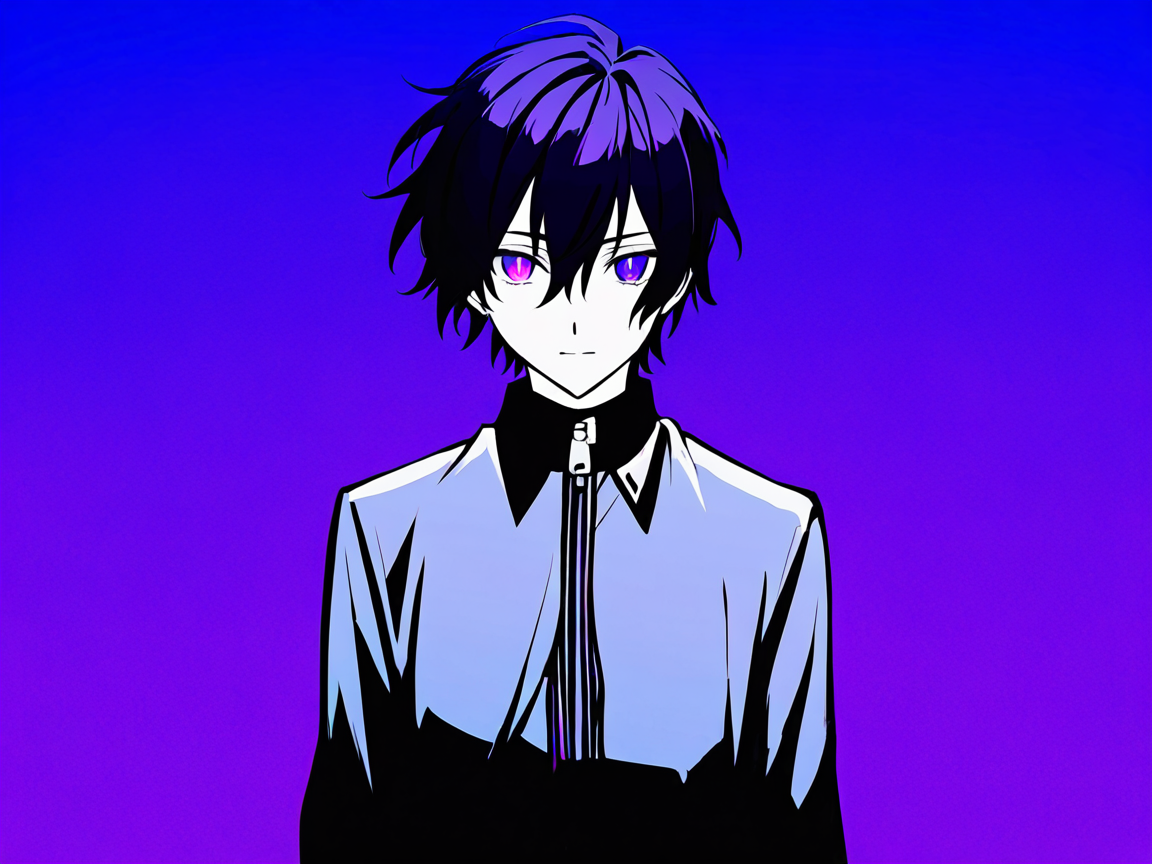
Yuichi Aoba — illustration from "Voices That Dwell in the Abandoned Hospital" Episode 1 "Grammar of the Scar Marks"
In the wall, there was a voice.  To be precise, it was not yet a voice at that point. The countless scratch marks carved into the waiting room wall, glimpsed through the broken glass—that was silence, at first. But Aoba Yuuichi's eyes read grammar into that silence.  The scratches had direction.  All of them pointed toward the exit.  Yuuichi spoke quietly into the voice recorder hanging from his neck. "First impression, recording. The scratches on the wall surface are not rough destruction. There is clear regularity in directional distribution and density."  His voice was slightly hoarse.  That's strange, Yuuichi thought. After 127 investigations, his voice shouldn't crack like this. But he consciously steadied his breathing and continued. "Suspending emotional interpretation. Recording as data."  The twilight filtered diagonally through the gaps in the broken window frame. The dust smell peculiar to ruins, the damp of mold, and something else—something far older—mixed in the air. Aoba Yuuichi felt his nose attempting to classify that "something else." But it could not. At the 128th investigation, for the first time, his sense of smell surrendered its definitions. ―――  That afternoon, Yuuichi had been eating cold soba at the only restaurant in Kirisuku Town—located in the mountainous region of northern Honshu, in Ishimine Prefecture, forty-five kilometers northeast of Ishimine City on the prefectural road, then another thirty minutes up an unpaved mountain path.  The eating establishment "Yamakasumi"—a counter and two four-person tables, that was all the narrow space contained. The proprietor, Sakuma Toshiko, had a straight spine despite her seventy-two years, and her gaze held something like appraisal. Yuuichi thought the residents of Kirisuku Town probably looked at people from Tokyo that way. Or perhaps they already knew where the person from Tokyo was headed.  Yuuichi opened his notebook and ate three mouthfuls of soba before asking. "Do you remember anything about the old Lapis?"  Sakuma Toshiko's hand paused above her tea cup.  Just for a moment. But Yuuichi's eyes did not miss that pause. "...It's better not to speak of that place."  That was all. There was nothing more. Toshiko withdrew into the kitchen and did not return.  Yuuichi wrote in his notebook. *Resident rejection response—physical cessation preceded linguistic response. Possibility of suppression rather than fear.*  The soba was cold.  Three and a half hours by express train from Tokyo, forty-five kilometers northeast from Ishimine City on the prefectural road, then thirty minutes on foot up an unpaved mountain path. Kirisuku Town had a population of 3,800, an aging rate of 42 percent, a mountain settlement. No railway ran through the town. Mobile phone signals were stable only around the post office; everywhere else, the place was quietly severed from the outside world. That was one reason Yuuichi had chosen this location—closed places held closed memories more easily.  After paying, he stepped outside. The mountain air at one in the afternoon had a different quality than Tokyo's. Thin, cold, somehow transparent. The distant cedar forest swayed in the wind. Beyond it, a hill.  Yuuichi was thirty-two years old, 175 centimeters tall, with a slender, well-proportioned frame. His jet-black short hair had a natural wave, and his deep indigo eyes appeared nearly black in this light. A pale gray jacket, black pants, a dark navy collared shirt—he had a habit of choosing functional, unobtrusive clothing. Experience had taught him that it was better to erase one's presence at investigation sites. A small piercing in his left ear. And around his neck, always, the neck strap of audio equipment. Today he carried an IC recorder compatible with infrasound and a small EMF meter.  He was a paranormal researcher.  That title had no official certification system in Japan; anyone could claim it. But to continue as a professional required at least fifty documented investigations and accumulated reproducible data—an unofficial standard for academic institutions and publishers to commission work. An estimated thirty to forty professionals nationwide. Yuuichi was one of them. He had majored in acoustic engineering at university, specializing in anomalous voice analysis in the infrasound range. His annual income was approximately 2.8 million yen. His one-room apartment in Suginami Ward, Tokyo, was stacked with materials and equipment, with almost no living space remaining.  This was his 128th investigation. ―――  The forest road was supposed to take thirty minutes to climb according to the map, but it actually took forty minutes. The incline was steeper than expected, and walking on unpacked fallen leaves demanded more physical effort than anticipated.  When he reached the hilltop, the twilight light was illuminating the building's front face perfectly.  Approximately 540 meters elevation. Seven kilometers northeast of Kirisuku Town center. The old Lapis—formally, the Jikoukai Medical Corporation Lapis, once the only psychiatric medical facility serving this town—stood as a three-story reinforced concrete ruin. The exterior walls were covered in ivy, most windows broken. The entire structure seemed to be slowly, but certainly, sinking toward the earth under the weight of fifteen years.  Yuuichi first counted the windows.  From the first to third floor, twenty-three on the front alone. Of those, seventeen still had iron bars.  *(Many.)*  He murmured within his chest and ran his pen across his notebook. The installation of iron bars in psychiatric hospitals was normally limited to closed ward windows. For patient safety and management of restricted areas—or so it should be. But in this building, bars were installed even in what appeared to be the first-floor outpatient examination area. The density was different. The quantity was different. This was not a design to protect patients from the outside, but a design to keep patients from leaving, a hypothesis quietly assembled itself in Yuuichi's mind.  Still a hypothesis. Not evidence.  Yuuichi told himself this and began taking photographs. The angle of the evening light created long shadows, emphasizing the building's contours. Photographs of ruins taken in this light often appeared more dramatic than reality. So Yuuichi consciously suppressed emotion and concentrated on recording numbers. The number of bars, their spacing, installation height—all written in his notebook.  But internally, something was different.  The kind of professional composure cultivated over 127 investigations—it was wavering for the first time. Yuuichi did not know this sensation. He had just learned that he did not know it. ―――  More than half the glass of the front entrance was broken, but one small sheet-like fragment remained in the frame. Through that glass, the waiting room wall was visible.  At first, he thought it was a pattern.  The next moment, he knew it was not.  Claw marks. Countless claw marks covering the entire wall. But their distribution held none of the disorder of emotional destruction. All pointed in the same direction. Toward the exit, toward the front entrance, toward outside—they pointed.  "First impression, recording," Yuuichi said, and his voice cracked.  He entered the building ten minutes later. ―――  He established a temporary base in the first-floor reception lobby.  While deploying equipment, Yuuichi looked up at the ceiling. Peeling paint, cracked fluorescent light covers, dust accumulated on the counter. There is an expression that time has stopped here, but that is not precise. Time had flowed—fifteen years' worth, relentlessly. Only humans were absent.  He placed the EMF meter on the counter. Set the temperature recorder by the window. Fixed the infrared camera tripod toward the corridor entrance. The procedure was a motion he had repeated 127 times. His body remembered it.  During that work, he noticed a notice on the wall.  Faded paper held with tape. *Visiting Hours Notice* as a handwritten title. Below it, in bullet points.  —Visiting Days: Monday, Wednesday, Friday  —Hours: 14:00–16:00  Three days a week, two hours a day. Six hours per week.  Yuuichi stared at that number.  Visiting restrictions at psychiatric hospitals vary depending on patient condition and treatment policy. But measured against general standards, six hours per week was remarkably low. Physical restriction of external contact—or designed to restrict it. A notice to make visiting families accept "it's the rules" before they could ask "why." The possibility that external observation had been systematically reduced.  Yuuichi noted it in his notebook and opened the next page.  He took out the materials collected at the Ishimine Prefectural Library and copies of administrative records obtained through his own channels. This preparation had taken two weeks. The local history section of the library, public documents from the Ishimine Prefectural Government, and fragmentary council records obtained through multiple routes—when arranged, three facts emerged.  First. Between 2006 and 2008, four patients disappeared and two died under unclear circumstances.  Second. Upon closure in March 2009, patient transfer completion was officially recorded as completed in "seventeen days." A procedure normally requiring three to six months—why was it finished in seventeen days?  Third. Hospital director Tsuzuki Yoshinori submitted a change of residence notice to another prefecture two months before closure in January 2009 and disappeared after the closure.  How did these facts reconcile with the official explanation of "voluntary closure due to deterioration"? Yuuichi could not see a path of reconciliation. Each of the three facts might be explicable in isolation. But when all three existed simultaneously, they indicated something else.  Yuuichi closed the materials and dimmed the lantern light slightly.  Outside was complete night. Mobile phone signals did not reach this hilltop. The nearest point with signal reception was the post office seven kilometers away. The satellite phone was at the bottom of the equipment case—emergency use only. The old Lapis was now severed from the world. Perhaps this was the sensation the patients had felt—Yuuichi thought. He did not write that thought in his notebook.  Emotional interpretation was not recorded. ―――  Just past two in the morning, the IC recorder's numbers moved.  Infrasound range, below 20Hz. The level exceeded the baseline.  Yuuichi inserted the earphones and confirmed the real-time waveform data. The wave shape displayed on the notebook computer screen.  He first considered mechanical possibilities. Residual vibration in piping—fifteen years after closure, fluid in the pipes should have mostly evaporated, but metal thermal expansion and contraction could produce sound. Building resonance frequency—concrete deterioration could generate resonance at specific frequency bands. External environmental sound—at this elevation, wind passing through building openings could generate specific sounds.  He eliminated them one by one.  Piping sound waveforms held irregular impulse characteristics. This waveform was different. Building resonance concentrated at natural frequencies. This waveform held multiple frequency components. External wind sound had unstable phase. This waveform's phase was—  Yuuichi's fingers stopped.  The phase was stable.  The resonance structure of vocal cords imparts unique phase stability to speech. That differs from instrument resonance, from airflow sound, from mechanical vibration—a pattern only the human throat produces. Yuuichi had pursued this field of analysis for nearly ten years since university. So he knew.  This was human voice.  Multiple voices.  Multiple frequency components overlapping, interfering with each other, yet persisting without fading. Yuuichi attempted t
Voices That Dwell in the Abandoned Hospital Ch.1: Grammar of the Scar Marks | Free to Read