Episode 1

What is Novelia?

Novelia is an AI-powered platform to read original light novels and fan fiction, create your own in just a few taps, and chat with the characters. New, illustrated episodes arrive daily — free to start.

Learn more about Novelia →New sign-ups get 5,000pt
Whispers from the Abandoned Hospital Episode 1

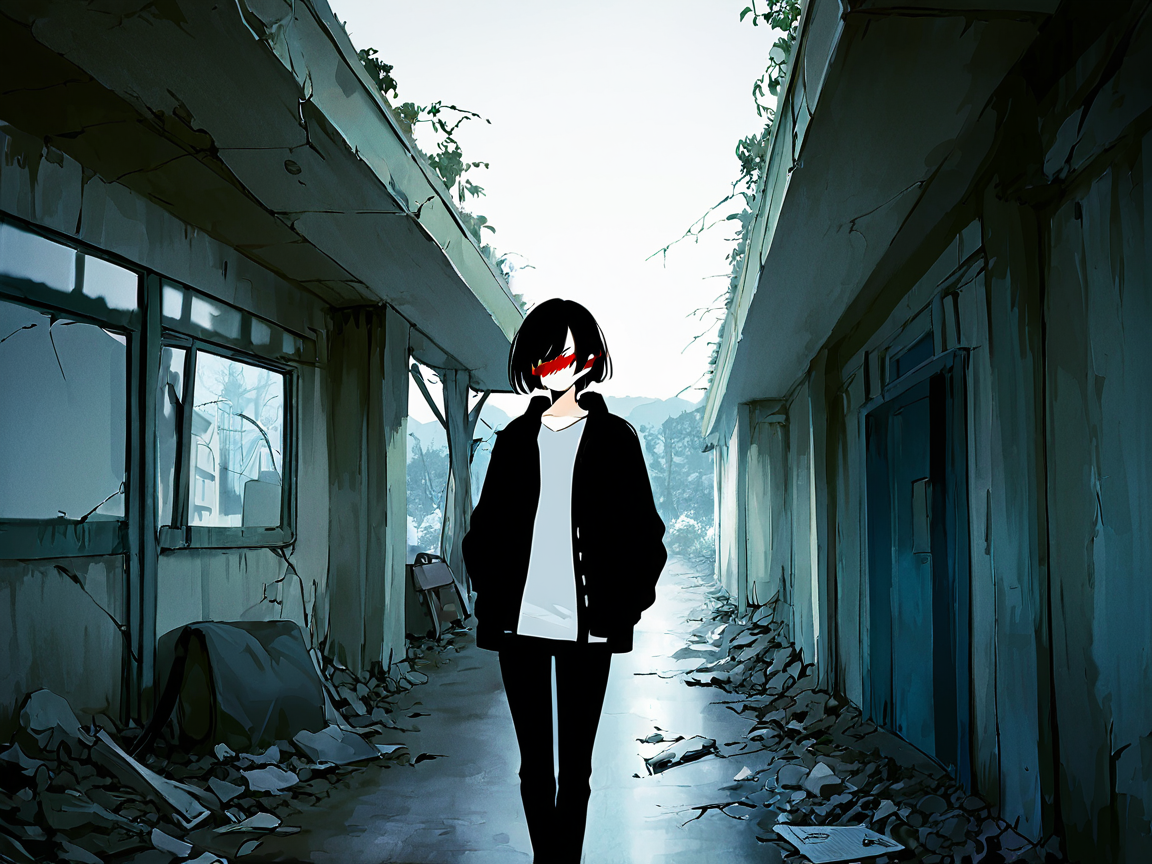
如月 澪 — illustration from "Whispers from the Abandoned Hospital" Episode 1 "Episode 1"
The autumn wind cut cold as Misaki Kisaragi stood before Hyousumi General Hospital. A reinforced concrete structure, three stories tall, built fifty-two years ago. Most of the window panes were shattered. Ivy crawled across the outer walls. The concrete was webbed with deep fissures. The automatic doors at the entrance had rusted shut, one side hanging half-open and immobile. Even past noon, an uncanny darkness clung to the building's perimeter. Misaki stopped and opened her notebook. Twenty-eight years old, black hair pulled back in a single braid. Deep brown eyes that reflected almost no emotion. At 170 centimeters tall, her slender frame was dressed in a navy investigation jacket, jeans, and gray trekking boots. A backpack containing measurement equipment hung from her shoulders. On her left wrist, a faint mark—something like a pattern—was etched into the skin. She let her pen move across the page. "Arrival time: 14:32. Temperature: 12.3°C. Humidity: 68%." She did not speak the words aloud. Misaki had always trusted measurements more than her own feelings. Feelings lied. But numbers did not. Or if they did, there existed a way to prove the lie. The reason Misaki had become this way traced back to childhood. When she was eight, her grandmother died. That night, Misaki said she had "seen her grandmother's ghost." She said it in front of her family, with a straight face, repeatedly. But no one believed her. Her mother consulted a psychologist. Her father dismissed it as "typical childhood imagination." Her schoolmates called her "that creepy girl who sees ghosts." In the end, whether something could be seen or not—if it could not be proven, it was meaningless. From that point, Misaki decided: she would believe only in what could be proven. Only in what could be scientifically observed. Only in what could be quantified. Three days ago, she had been dispatched by the Minagawa Institute of Psychological Science—a private organization researching the intersection of the paranormal and psychology. The request had come from a real estate company: a "psychological defect survey." Properties with psychological defects were places where deaths or suspicious incidents had occurred in the past, and their history diminished the property's resale value. Scientific measurement was required beforehand. This ruin was slated for redevelopment. Before proceeding, the presence or absence of "paranormal phenomena" needed to be scientifically measured. The Minagawa Institute had its own definition: "residual psychic waves"—subtle energy vibrations accompanying phenomena attributed to hauntings. Could they actually be measured? It was a critical question affecting the property's valuation. Misaki removed a portable measurement device from her investigation backpack. A Specter Meter. Independently developed by the Minagawa Institute, a residual psychic wave detector. A black box fifteen centimeters wide, ten centimeters deep, equipped with an LCD screen and multiple sensors. It cost 480,000 yen. By combining extremely sensitive electromagnetic, radiation, and temperature sensors, it quantified minute environmental changes that ordinary equipment could not detect. Over twelve previous investigations, Misaki had judged this device a reliable tool. She powered it on. A beep. The screen displayed "READY." Ambient readings loaded. "0.7" Normal values. Standard for a ruin. But— Misaki stepped into the hospital entrance. The sensor responded. A series of beeps—not an alarm, but a prompt for attention. The LCD numbers climbed. 1.2 1.8 2.4 And then— 5.8 "More than five times normal." Misaki recorded the figure silently. Only the sound of her pen echoed through the dim reception lobby. Inside the front entrance, part of the ceiling had collapsed. Concrete fragments scattered across the floor. Through the gaps, autumn light filtered in. Fallen leaves and traces of small animals lay underfoot. For twenty-one years, no human hand had maintained this building. Misaki proceeded carefully, without hesitation. A consultation room door swayed half-open. Wind. The broken windows allowed external air currents to flow through the building. Misaki removed a flashlight and traced the airflow. She measured with a thermometer. The temperature difference from outside air was 3.2°C. A physical explanation existed. "Judge by data, not emotion." That was her principle. Paranormal phenomena were, in essence, merely "phenomena science has not yet explained." Someday, all of it would be explained. Until then, Misaki would simply continue measuring. She headed for the stairs. From the first floor to the second. The stair railing was corroded. The treads were partially rotted. Her footsteps echoed through the building with raw clarity. She climbed each step with care. The moment she reached the second floor— The Specter Meter showed an anomaly. Beep-beep-beep-beep-beep— Continuous warning tones. The LCD numbers spiked. 12.3 15.7 18.3 "Measurement impossible..." Misaki's expression tightened. This was her first experience of this kind. Normally, even in ruins, readings maxed out around 3.0. This had jumped suddenly to 18.3. The hallway before the second-floor nurse station. Dim despite the daylight. The fluorescent lights were long dead, and some windows were boarded over. Her flashlight beam cut through the dusty air. The Specter Meter's readings fluctuated as she passed each patient room. Room 301: 12.1. Approaching Room 302— Beep-beep-beep-beep-beep-beep-beep-beep-beep-beep————— Continuous warning tones. The LCD screen trembled violently. The numbers would not load. "ERROR" Red text displayed. Measurement impossible. The device's maximum sensitivity could not quantify the anomaly in this room. Misaki took a deep breath. She placed her hand on the doorknob of Room 302. It did not budge. There was no external lock. But something inside seemed to be pressing against it—a resistance, as if the door were held shut from within. Misaki applied force. She put her whole body into it. The door did not move a single centimeter. Impossible. This should not happen. Yet it was happening. Misaki repeated deep breaths, trying to recover her composure. "Science cannot explain it. Or rather, I simply have not yet found the method to explain it." She repeated this to herself, over and over. She retrieved a thermal imaging camera. It measured the door's temperature distribution via infrared. The screen displayed color-coded temperatures. The surrounding walls were deep purple—temperatures consistent with the ambient air. But Room 302's door alone was dyed a deep indigo. "3.7°C colder." On an autumn afternoon, not winter, that door alone was abnormally cold. Misaki recorded it. Her pen tore across the notebook with force. She moved to Room 303. The door opened easily. Inside was dim, dust swirling. An old bed, an IV stand, a small chair. Clearly a pediatric room. She looked at the wall. A child's drawing remained—flowers in red and yellow crayon. Small handwriting: "Pretty, isn't it?" She activated the Specter Meter. 9.4 Not as severe as Room 302, but nearly ten times normal. Misaki sat down on the floor. She removed a thermos from her backpack, unscrewed the cap to use as a cup, and poured coffee. The warm liquid touched her lips. Just that small act eased her tension slightly. She opened her notebook and reread the materials. "Hyousumi General Hospital. Opened 1972. Closed 2003. Between the 1990s and early 2000s, multiple patients died under suspicious circumstances—deaths medically difficult to explain. Notably, in January 1998, a patient named Hina Tachibana, age 11 at the time, died suddenly while hospitalized. The official cause of death was listed as 'sudden death,' but medical justification remains unclear. Contemporary newspaper coverage was extremely brief, with no detailed explanation or family comments recorded. Possible cover-up suspected." An eleven-year-old child had died in this room. And that death had been deemed "suspicious." Medically unexplainable. Or— Perhaps medically explainable, but deliberately concealed. Misaki had reviewed the Hokushin Mainichi newspaper microfilm the previous night. A small article from January 1998: "Patient Dies at Hyousumi General Hospital." Hina Tachibana, age 11, death from illness. No further details. No explanation of cause. No family comments. Nothing. Unnaturally brief. Or unnaturally concealed. Misaki drained her coffee. She proceeded through Rooms 305, 306, 308, taking measurements. Each room's residual psychic wave readings differed. Room 301 was 12.1, Room 303 was 9.4, Room 304 was 11.7, Room 305 was 13.2— But beneath the variation, she sensed a pattern. Misaki began drawing a graph in her notebook. Horizontal axis: "Room Number." Vertical axis: "Reading." She plotted points and connected them with lines. Irregular. Yet overall— There was a pattern. The readings from Room 306 onward showed a slight upward trend. And Room 302's value was unmeasurable. In other words, the maximum. "Something is concentrated here." She felt it with certainty. She disliked the term "paranormal phenomenon," but at minimum, "something anomalous" was concentrated in Room 302. Dusk approached. Outside the window, autumn's sun descended. Long shadows fell across the hospital corridor. Misaki checked the Specter Meter's battery. Six hours of operation remained. But she would stop here for today. Misaki stood and left the hospital. She descended the stairs. Reached the first floor. Headed toward the front entrance. Cold autumn air greeted her outside the building. She turned back. The hospital's black silhouette. She gazed toward Room 302. The setting sun cast red light through the second-floor window. Then— Behind her, a faint sound. "Creeeak..." A door's hinge. Room 302's door. It opened just slightly—mere centimeters. But Misaki did not turn around. She shouldered her backpack and began walking toward the inn. Her heart maintained its rhythm. Yet she noticed her pulse quickening faintly at her left wrist. Tomorrow, she would enter Room 302. With that resolve, Misaki walked into the cold autumn wind. Behind her, the hospital seemed to wait for something still.