Episode 1

What is Novelia?

Novelia is an AI-powered platform to read original light novels and fan fiction, create your own in just a few taps, and chat with the characters. New, illustrated episodes arrive daily — free to start.

Learn more about Novelia →New sign-ups get 5,000pt
The Song I Cannot Hear, The Score I Cannot See Episode 1: A Port Town Too Quiet

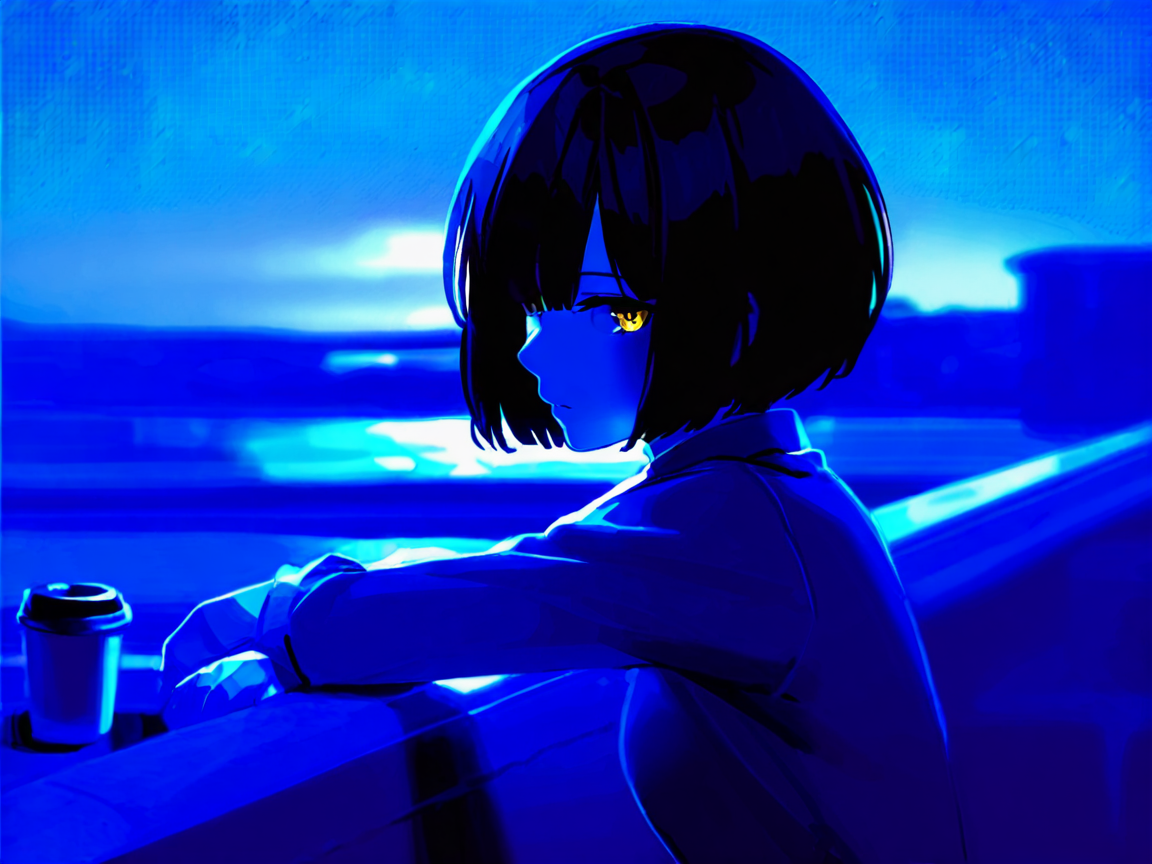
Sakuramiya Kotoha, Misaki Gen — illustration from "The Song I Cannot Hear, The Score I Cannot See" Episode 1 "A Port Town Too Quiet"
She still dreamed of the day her voice disappeared. Her hand gripping the microphone. The sound that should have filled the venue. And yet she heard nothing, collapsed to the floor, and that was all. When she woke, the world was completely silent. ◆ In November, Minato Saki smelled of tide from morning onward. Kotoha leaned her bicycle against the rack at the fishery cooperative. The cold sea breeze stirred her short black bob. She pulled the front of her pale blue cardigan tight and stepped inside the building. The fishery cooperative office. A prefabricated two-story structure. Fluorescent lights glowed white overhead, and five desks lined the room. Her coworker Yamada looked up and said something. His mouth moved. But there was no sound. Only noise. She wore hearing aids in both ears. But these were just machines that amplified volume. In Kotoha's case, the problem wasn't loudness. The hair cells in the cochlea of her inner ear were damaged—the mechanism for receiving sound itself didn't function. Even amplified by the hearing aids, the signal couldn't reach a broken receiver. Only the very lowest frequencies came through as vibration rather than sound, transmitted through her body. Everything else was noise. So Kotoha pointed to the notepad sitting at the edge of the desk. Yamada nodded as if understanding, and picked up a pen. *"Good morning! Could you organize the invoices today?"* Kotoha nodded. She lifted the corners of her mouth slightly, forming the shape of a smile. This was the morning of "Kana." Kana. That was Kotoha's name in this town. Not Sakuramiya Kotoha. Just Kana. The part-time office worker with bad hearing. Four days a week, 950 yen an hour, organizing invoices and receiving faxes—that was all she was. That was fine. For now, that was fine. She turned to her desk and arranged the invoices. Tai. Octopus. Squid. Seaweed. Catch amounts and prices were written by hand, and Kotoha typed them into the computer. Simple work. No need to think. No need to consider anything. That was what she was most grateful for. ◆ Lunch break. Kotoha sat on the breakwater of the fishing port. She hadn't brought a bento. For some reason, she had no appetite. The sea spread out before her. The Seto Inland Sea. Calm and gentle, as inland seas should be. The mountains of Shikoku hovered hazily across the water. She could see the waves hitting the breakwater. The water surface rippled, white foam was born and disappeared. But there was no sound. Waves were supposed to make sound. *Zapan*, or *gopo*. Sounds like that. Yet she heard nothing. Only the scenery remained. A world without sound, like looking through the glass of an aquarium. Kotoha hugged her knees. She was remembering a year ago. November in Osaka. A concert hall stage. It was the day-before rehearsal for Hikari no Uta's final national tour performance. Twelve cities, eighteen shows. Total attendance: 180,000. The very last of the tour. She held the microphone, waiting for the sound engineer's confirmation. Tinnitus started. At first it was small. She thought it was normal. She must be tired. But the ringing grew louder and louder, and— The next moment, there was the floor. She realized she'd fallen only after her face touched the cold stage. She felt the vibration of someone running toward her. But she heard no voice. Not from the beginning. Ambulance. Hospital. IV drip. A doctor opening his mouth. She heard nothing. Later they wrote it on paper for her. Sudden sensorineural hearing loss. If steroid treatment began within 48 hours of onset, recovery was possible. But because the onset happened during rehearsal, the response was delayed. By the time treatment started, the damage to the hair cells was already too deep. It had no effect. A person who debuted at nineteen, topped the Oricon charts, and sang in front of 180,000 people—at twenty-two, she could hear nothing. The gap terrified her. More than terrified—so terrified she stopped understanding it. Her feet dangled from the breakwater. The sea breeze touched her cheek. That sensation was all there was. Her manager Kimura had said, "Let's retire." Since then, Tornado Music's contact had dwindled. The people she'd thought were friends disappeared one by one. Kotoha came here. Minato Saki. A small port town of 3,800 people near the border between Hiroshima and Okayama prefectures. A place where no one knew Kotoha. A place where no one would think Sakuramiya Kotoha existed. She chose only that, and came here. ◆ After 3 p.m., she stopped by Café Umineko. An old wooden two-story café on the corner of the shopping street. The exterior paint was white and peeling from the sea breeze, and a hand-painted wooden sign hung at the entrance. Inside, dark brown wooden interior and the smell of coffee. Four seats at the counter, ten at tables. The fishing port was visible from the window seats. They apparently had a policy of no background music. It was always quiet. Master Misaki, the owner, looked up as if sensing Kotoha's presence. Sixty-four years old. A former deep-sea fisherman. White hair, sun-darkened face, few words. Misaki said nothing to Kotoha. Asked nothing. Not who she was, not why her ears didn't work—nothing at all. When Kotoha sat at her usual window seat, Misaki walked over from behind the counter and placed a notepad and a blue wave-patterned coffee cup on the table. Somehow, this blue cup had become Kotoha's. They hadn't decided it that way. One day it just was. Kotoha wrapped both hands around the cup and confirmed its warmth. The aroma of coffee reached her nose. Only here could she breathe. Misaki returned behind the counter. He was wiping something with a cloth. Today, Kotoha was the only customer. A small television sat against the wall. No sound came from it, and it didn't matter to Kotoha anyway. But the screen was on, showing what looked like a music program. A young female singer. White stage costume. Holding a microphone, smiling. Kotoha couldn't look away from the image. That smile. Singing with a smile like that. Her mouth opening wide, closing, opening again. The audience waving glow sticks. Kotoha's hand went to her own throat. She realized she was doing it. What would happen if she made a sound? For a singer, voice control was everything. Was the pitch correct? Was the volume appropriate? Was the emotion there? The way to confirm that was through the ear. Hearing your own voice, adjusting it. That was what singing was. But Kotoha couldn't do that confirmation now. She had no idea how her own voice sounded. Whether she'd become tone-deaf, whether it came out normally, whether it had become strange. There was no way to check. That fear had made her unable to produce sound. It was like being naked on stage, she thought. Producing sound in front of people without being able to control it. At least, for Kotoha, it was. She gripped the coffee cup tight with both hands. She looked away from the television. Misaki said nothing. He just kept moving the cloth behind the counter. That was fine. He didn't need to say anything. This silence was what Kotoha was most grateful for. ◆ At night, she returned to room 203 of Corpo Shiokaze. A corner room on the second floor of an old apartment building, thirty-eight years old. One six-mat room with a mini kitchen and unit bath. Rent was 28,000 yen a month, management fees included. The only furniture was a bed, a small table, and storage boxes. She'd brought no CDs from before, no certificates, nothing. The fishing port was visible from the window. The night sea was dark, and the harbor lights reflected in scattered points. Kotoha sat on the bed and opened her smartphone. She opened an app. A video site. She typed "Hikari no Uta" in the search box. Official live footage appeared. She pressed play. But she left her earbuds out. Complete silence. In the screen, there she was. Sakuramiya Kotoha at nineteen. White stage costume. Spotlights on her, holding the microphone in both hands. Her mouth wide open. Singing. Smiling, looking happy, giving everything. The audience in the venue had their hands raised. Countless hands swaying in the air. 180,000 people. Kotoha placed the smartphone on her lap and kept watching the screen. In the silent footage, she was singing. Following only the movement of her mouth with her eyes. This part must have been high notes. The audience reacted most strongly here. That bridge melody—she'd written it herself. One night at nineteen, crying. Now, even producing sound terrified her. That version of herself had feared nothing. Because she could hear. Because she could hear her own voice, she could believe in it. Tears came. Before she knew it, her cheeks were wet. Crying without being able to make a sound. Unable to cry out loud because she was afraid—afraid of not being able to confirm how her own crying sounded. So she cried silently. Watching silent footage, shedding soundless tears. When she realized that, she couldn't stop. She thought: even her voice had been taken. Not just her hearing, but her voice. Her song. That version of herself on that stage—all of it. On the screen, Kotoha was smiling. The current Kotoha looked down and kept crying. Without sound. ◆ The next morning. On the commute to the cooperative. November mornings had cold air. Leaving Corpo Shiokaze, passing through the shopping street, walking toward the fishing port. The same route four days a week. The shopping street was still mostly closed. Shutters more than half-drawn. She walked past Matsuura Fresh Fish Shop, which opened early—the smell of fish reached her. To get to the fishing port, she could just go straight through the shopping street. But this morning, for some reason, she looked west. Kanazuchi Street. Walking west from the shopping street, there was an old factory district. Remnants from when this town had prospered in shipbuilding, seven or eight abandoned factories lined up. A desolate street about 300 meters long. Only three streetlights, so it was dark after evening. Locals said "there's nothing over there" and didn't go near it. Kotoha had never been there before either. But this morning, her feet turned that way anyway. She had time. She'd left home ten minutes early for the cooperative. She entered Kanazuchi Street. Abandoned factories lined the way. Rusted shutters. Broken window glass. Signs tilted, text unreadable. It smelled of old oil, salt, and the accumulation of time. No one was there. It was quiet. For Kotoha, quiet was normal, but this quiet felt different somehow. The air felt different. Then. Something moved deep in her body. A vibration. A faint tremor reached the center of her chest. Not sound. Not something she could recognize as sound. But something was definitely coming. Only the very lowest frequencies, arriving as vibration through her body—that was happening now. Kotoha stopped walking. For more than ten months, she'd felt nothing. Even with the hearing aids on, nothing but noise reached her. Yet now, something was coming. From where? Slowly, Kotoha removed her hearing aids. Left ear, right ear. She put them in her pocket. In complete silence, she stilled her body again. It was still there. Coming from deeper in the factory district. From the direction of the street's end. Before she knew it, she was walking. One step. Another step. Like being drawn in. Not something she was thinking about and doing. Her body was moving on its own. She passed between the abandoned factories. Through gaps in the rusted steel frame, she could see the sky. A pale water-blue sky. The calm morning sky of the Seto Inland Sea. At the end of the street, there was one building. Different from the abandoned factories. Old, but the windows weren't broken. A single-story steel frame structure with a high ceiling. At the entrance, a small wooden sign hung. *Tuning.* One word, written by h
The Song I Cannot Hear, The Score I Cannot See Ch.1: A Port Town Too Quiet | Free to Read