Episode 1

What is Novelia?

Novelia is an AI-powered platform to read original light novels and fan fiction, create your own in just a few taps, and chat with the characters. New, illustrated episodes arrive daily — free to start.

Learn more about Novelia →New sign-ups get 5,000pt
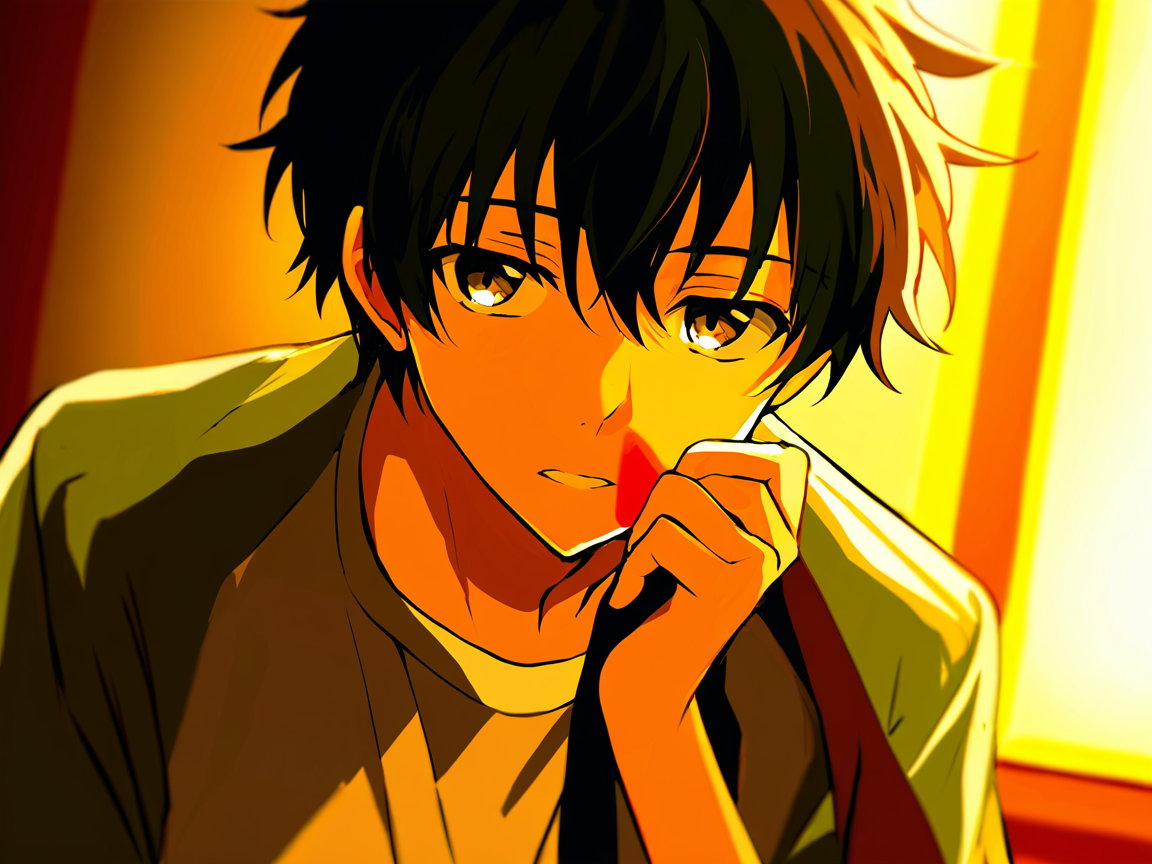
Ashes of Memory—The Kuizaki Family Secret Episode 1: A Letter Without a Postmark

Fumiya Sakakibara — illustration from "Ashes of Memory—The Kuizaki Family Secret" Episode 1 "A Letter Without a Postmark"
The hand stopped. He did not know why. Whether it was emotion, or the last instinct left in a creature called a journalist—Fumiya Sakakibara could not tell. Only, the letter he had been about to crush trembled faintly between his fingers. Three hours earlier. A thirty-four-year-old one-room apartment in Akabane, Kita Ward, Tokyo. Third floor of a six-story building, twenty-five square meters—the room told the honest story of its occupant's history. Three empty beer cans leaned against each other in the corner of the desk. Stacks of books sat half-collapsed and abandoned, and bundles of interview notebooks lay scattered across the floor—as though they were the wreckage of a former profession. A book review commissioned by *Nagisa Bungei*, a bimonthly literary magazine with a circulation of about eight thousand. Fumiya had been finishing it at his screen. The writing on the screen was not bad. The vocabulary was refined, the argument clear, and a respect for the author permeated the prose. The problem was that the man writing it did not believe a single line. Fumiya stroked his jaw, faintly stubbled, with his left hand. The motion brought his fingers against a small scar on his left ear. A wound from twelve years ago, sustained while covering a string of disappearances. It no longer hurt. That it no longer hurt sometimes struck him as strange. Short black hair with a slight wave. Deep brown eyes that had once been called sharp. White shirt sleeves rolled to the elbow, black slacks creased with wrinkles. His slender build was, well, more or less maintained—though lately he had stopped making that excuse to anyone. The going rate was twenty to forty thousand yen per piece. Three or four a month, roughly 2.4 million yen a year. Rent: sixty-two thousand. The only reason he could keep living in this room was that the arithmetic barely balanced. It was rational. Everything had been a rational descent. His gaze drifted to one corner of the shelf. Only that place was different. Everywhere else was scattered, piled up, forgotten—yet one corner of the shelf was meticulously ordered. Five black files, spines aligned. The labels, handwritten: *Itabashi Serial Disappearances*. Beside them, a thin folder. No label. Inside was the article containing Fumiya's own false report. The false report from five years ago. At thirty-seven, Fumiya had carried twelve years of experience as a staff writer in the social affairs division of the *Toyo Times*, known as a specialist in missing-person cases. The social affairs desk of a national paper with a circulation of about 1.8 million was a large organization—roughly ninety reporters. Within it, Fumiya had pursued the serial disappearances in Itabashi Ward through his own independent reporting. Four people had vanished in three months. The police moved slowly. Fumiya moved. And he made a mistake. Confirmation bias, the later post-mortems called it. Overconfidence in a source, they also said. Fumiya had named a certain individual as a suspect. The morning after the article ran on the front page of a national newspaper, that person left his workplace, and a week later attempted suicide. He survived. He is still alive somewhere—somewhere. Even now, Fumiya sometimes nearly speaks that person's name aloud. As if in penance. He clicked the mouse and sent the manuscript. That was all. Past midnight, only the hum of the air conditioner remained in the room. Fumiya let his weight fall against the backrest and looked up at the ceiling. There was a single stain on the wallpaper. It had been there since he moved in. Three years, and it was still there. (*I wrote a book review. I did my work. That's all.*) He stood and went to check the mailbox. It was habit. The envelope was there. A thin, white envelope. No postmark. The address was neither printed nor typeset but handwritten. *Fumiya Sakakibara-sama*—neat, yet restrained, as though the writer had held back force. The sender's line was blank. Envelope in hand, Fumiya stood for a while on the stair landing. In the late-night common corridor, the sound of the distant highway arrived low. He returned to his room and broke the seal. A single sheet. The writing was short, in a style that seemed to have stripped away all emotion. In Kirizumi, Gunma Prefecture, three people have gone missing within the past six months. The police quickly scaled back the investigation, treating them as voluntary disappearances. All three were recent transplants to the town, and there exists a structural similarity to an event that occurred here sixty years ago that cannot be ignored. I am aware of that similarity. But I cannot act. I need a journalist who can write the truth. The signature—Kanae Kuizaki. Fumiya's hand first stopped at the phrase *a journalist who can write the truth*. The next moment, something violent surged up in him—the recognition that those words were aimed at him. Something like mockery, yet not quite laughter. *Me? A journalist who can write the truth? The man whose conviction destroyed another person's life five years ago?* He tried to crush the letter. The hand stopped. He did not know why. Past one in the morning, Fumiya took the Itabashi case files down from the shelf. Before he had decided which drawer to open, his body was already moving. For five years he had kept the files in perfect order, yet he had almost never opened them. Opening them and keeping them arranged were different acts. He read the false article. His own prose. His own logic. The conclusion he had built from his reporting. How utterly convinced he had been back then—reading it now, it hurt to see. There was no hesitation in the writing. Prose written without a shred of doubt is always easy to read. There is such a thing as an easy-to-read lie. Fumiya traced the name in the article with his finger. That man is still alive. Somewhere, after the suicide attempt that Fumiya's reporting pulled the trigger on. He knew he was taking refuge in the phrase *somewhere*. He knew it, and still he kept thinking *somewhere*. He did not believe he had the right to step any further in. This was the substance of five years. For five years, Fumiya had forbidden himself to trust his own judgment. Every time he tried to observe, to gather information, to construct an argument, the prose of that article came back to him. A beautiful mistake, brimming with conviction. So he wrote book reviews. He evaluated other people's writing. If he never touched primary sources, he could never make a mistake. From a safe place, he lined up safe words—that was the true nature of his current work. (*I need a journalist who can write the truth.*) The line from Kanae Kuizaki's letter repeated in his mind. Fumiya picked up his smartphone and was already searching the JR Joetsu Line timetable. Before the thought that tried to rationalize his motive, his fingers had moved. He did not permit himself to call this a journalist's instinct. Instinct is not always right. Instinct can nearly kill a man. Even so, Fumiya brought the Joetsu Line timetable up on his screen. On the train bound for Numata Station, Fumiya simply watched out the window. Since leaving Ueno in Tokyo, the scenery had been changing by degrees. High-rises became low-rise housing, then rice paddies, and the distant ridgeline drew closer. The Joetsu Line was running toward the mountains. An obvious fact, and Fumiya registered it as though for the first time. It was not merely a change of scenery. The city is a place that grants a person the protective membrane of anonymity. Neighbors whose names you do not know, streets where eyes meet and pass on, a place where no one carries anyone else's history—within that anonymity, Fumiya had spent these five years. Kirizumi sits in the mountains of northern Gunma. A town of about thirty-two hundred people, its settlement stretched thin along the Mikura River. Two hours and ten minutes from Tokyo to Numata Station, then fifty minutes by an Okutone Kotsu route bus. The poor access physically underscored the town's closed nature—Fumiya recalled that passage from Kanae Kuizaki's letter. A closed community. An exposed space. And he was heading toward it. (*Are you sure about this?*) He asked himself, and found no answer forthcoming. He did not yet have the material to judge whether it was right or wrong. His body was moving before the material was assembled. That was the problem. It had always been the problem. When he stepped down onto the platform at Numata Station, the air was different. Dry, and a little thin. It had a different weight from Tokyo's air. Fumiya adjusted the shoulder straps of his large backpack and left the station building. He sat on the bench at the bus stop and checked the time. The next Kirizumi Line departure was 12:40. The Okutone Kotsu route bus ran only three times a day—7:20, 12:40, and 17:50. It was now a few minutes past noon. He had made it—or rather, he had left home working backward from the timetable in order to catch this bus. His hand went into his pocket. A lighter. The fact that he was in his third year of not smoking came back to him the instant his fingertips touched the lighter. Fumiya returned it to his pocket. There was no need to strike a flame. The urge could be mastered. It should be. A single dead leaf lay at the foot of the bench. Perhaps it had come from the mountains; the dry wind spun it once and carried it onto the asphalt. Fumiya thought nothing in particular and followed its trajectory with his eyes. The route bus was quiet inside. Four passengers, including Fumiya. Two local old women sat in the front and middle seats, each holding a large shopping bag in both hands. They had exchanged a nod when boarding, but after that they spoke no words. A long acquaintance's silent intimacy. The driver glanced at Fumiya's backpack. Where had he come from, what had he come to do—the gaze seemed to contain such questions, but the man said nothing. Fumiya said nothing either. Once the bus started, the townscape broke off almost at once. Past the Numata city center, the road cut into the mountains. The bus threaded its way along the Mikura River—a tributary of the Tone River system, flowing north to south through the center of Kirizumi. The river was not especially wide, but the sound of the water reached even through the window. The water of early autumn should not yet be cold, and yet somehow it sounded cold. The light outside the window fell by degrees. As the mountains drew nearer, the sky narrowed. Mist began to drift low along the river. Not white—a pale gray mist, rising from the water's surface, or perhaps sinking toward it; it drifted in a motion that could not be judged either way. The origin of the town's name, *Kirizumi*—Fumiya understood it as a felt reality for the first time aboard the bus. *Mist accumulates.* Not only snow is something that accumulates. Kanae Kuizaki's letter remained in his jacket's inner pocket. He had not taken it out once. He remembered it. He remembered all of it. Not because he had read it many times, but because he had read it once and it had been carved into his brain. The structural similarity to an event sixty years ago. A journalist who can write the truth. The mass of those words sat quietly, with weight, inside his pocket. The bus entered a tunnel. For a moment, complete darkness. Outside the window went black, and only the fluorescent lights inside the car cast their white glow. One of the old women checked inside her bag. The other had her eyes closed. The driver looked only ahead. Fumiya watched the darkness beyond the window, not thinking anything in particular. It resembles the darkness of these five years—once he noticed that, he let the observation go. *Don't take refuge in metaphor*—that had been his reporting philosophy. Write what you see as you see it. Do not record what you feel as you feel it; pile up only fac